MISOSOFI
®
みそそっフィ
Are you feeling overwhelmed by the idea of helping your child develop perfect pitch —
thinking it’s too much work to enroll in expensive classes or spend hours practicing with them at home on the piano?

(Perfect pitch is the rare ability to instantly name any note you hear — and it comes with amazing benefits, like playing instruments effortlessly and even boosting IQ!)
Sound like what you’ve been looking for?
No expensive lessons. No hours at the piano. Just listen and sing.
With the Misosofi Method, your child can naturally develop perfect pitch simply by looking at the picture books, listening to the audio, and singing along.
Discover the magical way to make perfect pitch fun — and natural.
For ages: from 6 months in the womb to around 6–7 years old
Created by our founder — a top graduate of Berklee College of Music in Boston!


Just listen and sing!
Develop perfect pitch through a picture book!
Misosofi Perfect Pitch Picture Book Set
(with 12 audio albums)
What is Misosofi?

The name “Misosofi” comes from the note names mi, so (twice), and fi (the English name for F♯).
In the first volume of the Misosofi Perfect Pitch Picture Book Method, a mysterious chicken character appears. Its crow, “cock-a-doodle-doo,” sounds like mi-so-so-fi — and that’s how the name “Misosofi” was born.
↑Click here ♪
Preview of the Misosofi Perfect Pitch Educational Picture Book Story

“Perfect pitch is said to develop when trained at a young age.”
And acquiring perfect pitch doesn’t just help with music — it benefits many areas of life, such as learning languages.
The Misosofi Method was created to help build this strong foundation for your child. We’re here to help you give them the lifelong gift of perfect pitch — a treasure they’ll carry forever.

We wanted to create a program that lets children enjoy listening, learning, and discovering a love for music — so that perfect pitch develops naturally along the way.
That’s the passion behind the Misosofi Method. And beyond perfect pitch, it’s packed with amazing benefits like boosting IQ and more!
There are countless benefits to developing perfect pitch, but…

…here are just a few examples.

The Misosofi Method is incredibly simple. Just listen to lots of good music, mimic the songs from the picture book and the included audio, and sing along in solfège. When done the right way at the right age, developing perfect pitch isn’t difficult at all.

Photo example: 1 year 11 months old
The picture book shown above is a sample. The actual book may differ in design.
The video below shows children who developed perfect pitch with the Misosofi Method being tested.

Most existing perfect pitch programs don’t actually train children to develop perfect pitch through music. Instead, they focus on playing single notes or chords on the piano over and over — which makes it hard for children (and parents) to stay motivated, and it doesn’t help them see the bigger picture of music.
The Misosofi Method, on the other hand, nurtures perfect pitch through fun picture book stories and music. This way, children develop not only perfect pitch but also all the other essential elements of musicianship at the same time.
When children truly feel, “Music is fun!”, perfect pitch comes more naturally. And when the music they experience is of high quality, there’s no better music education for young children.
・・・・
Subscription Plans
“Three beautifully illustrated picture books by an artist and 12 audio albums performed by top musicians — what an incredible value!
And unlike other programs, it’s designed to nurture true musicality.
It even comes with playlists so you can listen to lots of great music.
…but with so much included, I wonder if I can really make the most of it…”

Don’t worry! Just follow the Easy Steps on our website, and you’ll know exactly how to use the picture books and all the audio in the right order.
Below is a quick overview of the steps 🎵


Playlist: A curated selection of songs from various genres, available to listen to on YouTube. Simply follow the instructions, click the link, and just play the music for your child each day — that’s all you need to do.
In Step 1, start by enjoying the story — look at the picture book and listen to the audio. During spare moments, play the playlist in the background.

Listen to the included soundtrack. Play it in the background during your child’s playtime, mealtime, or other spare moments.

Ti Fa So
Try singing along with the included Pre-Book. Also, use the Let’s Imitate! audio — sing right after the “Ready!” cue.
If you have more than one child, the older siblings will naturally join in when they hear it, and they’ll develop their ear for music too (though not perfect pitch).


How to tap “tan”

How to tap “tah-ah”

How to rest on “rest”
Mr. Quarter Note’s House
Making use of travel time.
She practiced tapping rhythms perfectly together with her big sister!
Start now with the Misosofi Perfect Pitch Picture Book!

When it comes to developing perfect pitch, starting early is absolutely crucial. The earlier you begin — as early as 6 months in the womb — the higher the chance of success. While children up to around age 6 can still develop perfect pitch, even a single month can make the difference between whether or not they acquire it. Start as soon as possible.
「みそそっフィ絶対音感教材えほん」 開発秘話
The Misosofi Perfect Pitch Picture Book Project began in September 2019 — and it took nearly four years to complete.
What started as a small idea turned out to be a long and challenging journey, far from what I had first envisioned.
We faced countless obstacles: musicians unable to come or record due to COVID-19 restrictions, studios unavailable when we needed them, even entire recordings getting lost. There were many moments when the results we hoped for just didn’t come, and we had to rethink the project’s direction again and again.
That’s why I’ll never forget how encouraging it was to have so many talented musicians and artists stand by me.
From the musicians who generously sang the piano pieces in solfège, to the many artists from all genres who joined in — they all truly understood and expanded on the heart of this project:
“I don’t just want children to train for perfect pitch — I want them to learn it through real, beautiful music.”
Thanks to their contributions, this project became something far richer and more multifaceted than I could have imagined.
And behind the scenes, the engineers, designers, and staff worked tirelessly to bring this picture book to life — a book that lets children smile, enjoy music naturally, and develop a lifelong love of it.
After many twists and turns, the Misosofi Perfect Pitch Picture Book is finally complete and ready to reach children and families everywhere.
This book is the result of countless setbacks and challenges, fueled by the passion and teamwork of so many people.
I believe that spirit shines through, and that it will help you and your child on your journey to perfect pitch.


Main Book (Core Material)
Currito and “What’s This Sound?”
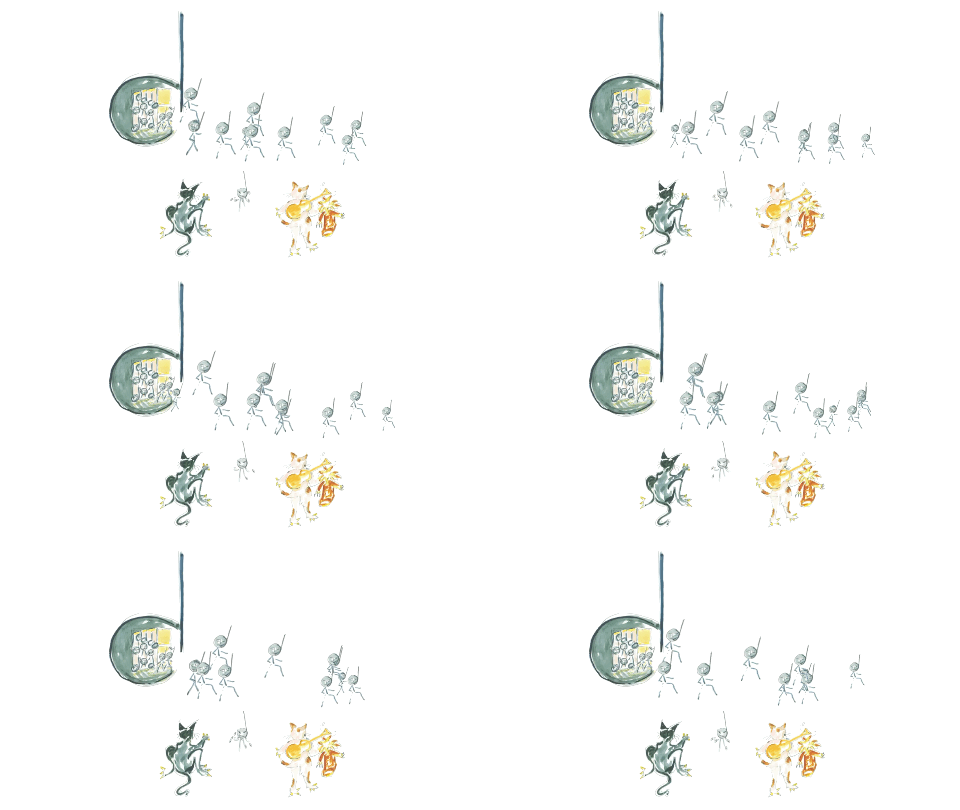
A slightly mysterious story featuring Currito, the black cat, and his friends.
The book comes with an audio recording that includes narration and music perfectly matched to the story.
With beautiful illustrations by Spanish artist Juan Macías, children can listen and follow along as they build the foundation for perfect pitch.
Includes picture book PDF: A4 size, full color, 64 pages.
If you prefer a physical book instead of the PDF, you can purchase it on Amazon.
The book shown above is a sample. The actual book may vary slightly in colors and text.


From the Main Book
Schumann’s Scenes from Childhood — Of Foreign Lands and Peoples is woven into the story, with narration and music specially arranged to make developing perfect pitch easier.


“Everyone, clap your hands together with Currito and follow Mr. Quarter Note:
‘tan tan tan tan’.”
— excerpt from the Main Book
It also includes exercises like this to help develop a sense of rhythm.


The Pre-Book introduces the characters that appear in the Main Book.
It comes with audio, so children can look at the book and listen to develop their perfect pitch.
For children old enough to sing, singing the songs from this book helps solidify their perfect pitch.
It also teaches basic musical terms that are great to start learning from around age 4.
Includes picture book PDF: A5 size, full color, 32 pages.
If you prefer a physical book instead of the PDF, you can purchase it on Amazon.
The book shown above is a sample. The actual book may vary slightly in colors and text.


The Pre-Book introduces the characters from the Main Book.
Each character has their own theme song, and once your child becomes familiar with the melodies, they can gradually start singing along.


The Exercise Book offers simple rhythm training, music reading practice, and basic musical terms — the foundations of music.
It comes with two audio tracks, and once familiar, children can practice on their own.
Recommended for ages 4 and up, but even younger children can benefit by listening and developing their sense of rhythm and perfect pitch.
Includes picture book PDF: A5 size, full color, 32 pages.
If you prefer a physical book instead of the PDF, you can purchase it on Amazon.
The book shown above is a sample. The actual book may vary slightly in colors and text.

Once your child can tap the rhythms well using the easy version of the Exercise Book, they can move on to the full Exercise Book.

Example of rhythm practice.
Practice along with the audio.

Example of note reading.
その他の付属品の内容

各絵本の
The Soundtrack lets you listen to the picture book’s music without narration.
The songs are sung in solfège (do-re-mi), so children can focus entirely on the music.


With the Let’s Imitate! audio, children listen to single notes or short melodies and sing them back right after the “Ready!” cue. This is where they firmly develop their perfect pitch.


Test how much perfect pitch your child has developed. (Available in both audio and video formats)


Contents of the Easy Steps
By accessing the members-only subscription page on the Misosofi website, you can access the playlists (see below), use the Easy Steps to work through the materials step by step, and download any necessary PDFs.

For most activities, it’s of course best to attend lessons and learn directly from a teacher. But when it comes to ear training and perfect pitch, that’s not necessarily the case.
Think of it like learning a language — babies don’t take lessons to start speaking. Instead, they listen to the language around them and hear their parents speaking to them, and over time, they naturally learn to talk.
Perfect pitch works exactly the same way. Even without going to lessons, children can develop it naturally at home simply by listening to plenty of music, hearing perfect pitch-specific exercises, and singing along.

During early childhood — when the ears are remarkably sensitive and the mind is a blank slate — it’s far more effective to expose children to high-quality performances by skilled musicians rather than typical “children’s music.”
Just as we want to give them natural, wholesome food to eat, and show them art and words that nourish their emotions and stimulate their minds, we should also give their ears music that will help them grow into sensitive, creative, and emotionally rich individuals.
Jazz PIanist Juan Galiardo

Graduate of Berklee College of Music. Jazz pianist.
Recorded and released her own leader album with renowned jazz musicians active in New York and Boston, and also recorded and released a CD with her R&B group, Satya Project, featuring the vocalist from Incognito.
Performed at numerous jazz festivals both in Japan and abroad.
Has participated in many CD recordings as a studio musician and sideman.
Notable collaborators include Jerry Bergonzi, Sheila Jordan, Joe Magnarelli, Gregory Hutchinson, Eric Alexander, Mark Whitfield, and many more.
Painter
Juan Gomez Macias

Painter. Born in 1950, from Spain.
Winner of numerous awards in national and international competitions.
Has held solo exhibitions across Europe and the United States.
Classical PIanits
Natalia Kuchaeva

Pianist. Born in Moscow, Russia.
Competition History
1998 — 1st Prize, Rubinstein International Piano Competition
2004 — Press Prize, Enschede International Piano Competition
2006 — 5th Prize, José Iturbi International Piano Competition
2008 — 2nd Prize, Scriabin International Piano Competition
Winner of numerous other international piano competitions.
Flamenco Singer Manuel Paralta

Top flamenco singer. Born in San Roque, Spain.
Has performed at numerous flamenco festivals.
Actively tours and performs in concerts around the world.
R&B Singer Thor Dulay

R&B singer. Based in the Philippines.
Winner of numerous awards over the years.
Released her debut album with Warner Music in 2004.
Soprano Singer Sachika Ito

Born in Kanagawa, Japan. Began studying voice at age 15 and moved to northern Italy at 20 to continue her training. Graduated with top honors and distinction from the Nicolini Conservatory in Piacenza in both vocal performance (2011) and chamber music (2014).
In 2006, she won 3rd prize at the Competition for Young Pianists and Opera Singers in Foggia, Italy, and 2nd prize at the Premio “Gianni Poggi”. In 2012, she received a scholarship from a vocal audition organized by the city of Montichiari in Brescia, and the same year won the Audience Award at the Certamen Nuevas Voces (New Voices Competition) in Seville, Spain. She has also been a finalist in numerous other competitions across Europe.
Jazz Singer
Tom Rust

Musician, singer, and DJ. Originally from the UK, currently based between the UK and southern Spain.
He has performed on prestigious stages around the world, including the VIP area at the Beijing Olympics, VIP areas at the FA & Carling Cup Finals, MSC Cruise Lines, the Royal Albert Hall, Porsche launch event in Amman, Jordan, the Sultan of Brunei’s superyacht on Sir Bani Yas Island, and a VIP residency at the Monaco Grand Prix, among many others.

Q: Will my child develop 100% perfect pitch with the Misosofi materials?
A: Unfortunately, we cannot guarantee 100% success. However, based on our experience, many children — especially those who start at an early age — do acquire perfect pitch. It’s true that it becomes harder as children get older, but even at 5 or 6 years old, some pick it up surprisingly easily.
Moreover, these materials are designed not only to develop perfect pitch but also to strengthen solfège skills, listening abilities, and overall musical ear, which all children will benefit from.
Q: How long does it take to develop perfect pitch using the Misosofi materials?
A: It depends on the child’s age when they start and how much music they’ve already been exposed to. Some children begin developing perfect pitch within 1–2 months, while for others it may take 5–6 years.
That said, by regularly playing the “Playlist” music in the background, and having your child sing along with the Let’s Imitate! track — even just 10 seconds a day — for at least 1–2 years, perfect pitch will steadily develop and improve.
It’s also important to spark your child’s interest in music by listening to the picture books together. We recommend always playing these materials — even from a smartphone (though ideally from a stereo!) — to create a musical environment at home.
Misosofi Founder
Atsuko Shimada

Born in Eniwa, Hokkaido.
Graduated from the Vocal Music Course at Sapporo Otani Junior College, Advanced Program.
Graduated top of her class from Berklee College of Music.
Former Yamaha Music Foundation System Instructor.
The Misosofi Method was born out of my 30 years of experience teaching music to countless children as a piano instructor. Throughout my career, I’ve always searched for the best way to help children reach their full potential and make music an irreplaceable part of their lives. Along the way, I discovered two key principles:
-
Foster a love of music by making it fun — because we all thrive when we’re interested and engaged.
-
Give children a “talent” — because confidence grows when we feel capable.
In music education, there are abilities that can only be developed during early childhood — one of them is perfect pitch. Giving children the gift of perfect pitch as a “talent” is at the very heart of the Misosofi Method.
I myself have perfect pitch and know firsthand how valuable it is. Since the beginning of my teaching career, I’ve always incorporated perfect pitch training into my lessons. But I noticed that some children developed it quickly while others struggled, and I was determined to find a way to help every child succeed.
Through years of research and practice, I came to appreciate the incredible power of music and began to envision a method that was not only effective but also enjoyable, engaging, and beneficial beyond just music — supporting children’s intellectual growth and future learning as well.
After much trial and error, this vision became the Misosofi Method.
My hope is that the children who pick up the Misosofi Method will have fun and stay engaged as they develop not just perfect pitch, but also relative pitch, rhythm, and a deep understanding of music — and that music becomes a source of strength and joy, enriching their lives for years to come.
Subscription
MISOSOFI
3-Book Set


Perfect Pitch Picture
Subscription Page Contents
(写真の本は別売になります。)


②オーディオ12アルバム
⓷2ビデオ
①えほん3冊(PDF)

④かんたん!ステップ


⑤プレイリスト

みそそっフィ絶対音感教育教材
会員サブスクリプションプラン
日本語1ヶ月プラン
59€Every month🌱 1ヶ月プラン 約9,617円 (税込) お試し感覚で始めたい方に最適。- 🌱 1ヶ月プラン特典内容:
- ・サブスクリプション会員限定ページへのアクセス
- ・チャットサポート
- ・オンライン個人ミーティング
- 📌 注意:教材はPDF形式です。紙の本はAmazonで購入できます。
日本語1年プラン
319€Every year🌳 1年プラン 約52,000円(1ヶ月あたり約4,333円) 1ヶ月プランより約55%お得!最もおすすめのプラン。7 day free trial- 🌳 1年プラン特典内容:
- 👑7日間無料トライアル付き👑
- ・サブスクリプション会員限定ページへのアクセス
- ・チャットサポート
- ・オンライン個人ミーティング
- 📌 注意:教材はPDF形式です。紙の本はAmazonで購入できます。
※ 当ウェブサイトに掲載されているコンテンツ(文書、映像、音声、プログラム等)は、著作権法、関連条約・法律で保護されています。これらのコンテンツについて、権利者の許可なく複製、転用、販売等する事は法律で禁止されています。
尚、当ウェブサイトの内容を雑誌、書籍、CD-ROM等へ転載、掲載する場合は、事前にみそそっフィへご連絡下さい。